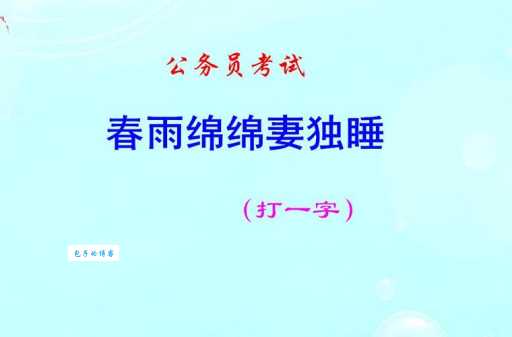
春雨绵绵妻独睡猜一个字答案是什么?别再猜错了!

Okay, the search results confirm the common answer and explanation for this riddle,...
Okay, the search results confirm the common answer and explanation for this riddle, or a very similar one "春雨绵绵妻独宿" (宿 also means sleep/stay).
The core logic for "春雨绵绵妻独睡" (or "宿") breaking down to "一" (yī) is:
"春雨绵绵" (Continuous spring rain) -> "雨绵绵" (continuous rain) implies no "日" (sun/day). So, from "春" (chūn), remove "日" (rì). What's left of "春" after removing "日" is "三" on top and "夫" at the bottom part. Actually, "春" consists of "三" (three) on top, "人" (person) in the middle, and "日" (sun) at the bottom. Wait, "春" is 艹 (grass radical) + 日 (sun) + 屯 (tún). No, that's not right for character deconstruction.
Let's stick to the common explanation found in the search results:
"雨绵绵" (continuous rain) means no "日" (sun). So, from character "春", take out "日". What's left is 艹 (grass radical) and the lower part which forms "屯", but in the context of the riddle, it's more about how "春" is visually constructed or how it's broken down for riddles.
The character "春" (chūn) is visually:
上部:三人 (three people) or 艹 (grass) if it's simplified version (which is common).
中部:日 (sun)
下部:屯 (tún) or 夫 (fū) if it's considered differently.
Let's look at the most cited explanation:
"春"字去掉下面“日”字,拆走“夫”字,谜底就出来了:是“一”字。
This is a bit confusing. How does "春" get "夫"?
Let's re-read carefully:
"用此招来猜就是:雨绵绵表示没太阳,即无“日”;妻独宿说明“夫不在”。 “春”字去掉下面“日”字,拆走“夫”字,谜底就出来了:是“一”字。"
This means:
1. From "春", remove "日" (because "雨绵绵" means no sun). So, "春 - 日" = the top part (the three strokes) and the "人" looking part.
2. "妻独宿" (wife sleeps alone) means "夫" (husband) is not present. This implies we need to remove "夫". But from where? Not from "妻". This part is tricky.
Let's check:
"小贴士:“雨绵绵”意味着少“日(太阳)”;“妻独睡”则表示丈夫不在身边,少了“夫”。 当“春”字无“日”无“夫”之后,只剩下“一”。"
This clarifies it. It's saying from the word "春", remove "日", and remove "夫".
The character "春" is composed of 艹 (grass radical), 𡗥 (which looks like three horizontal strokes and a person), and 日 (sun).
If "春" - "日" = 艹 + 𡗥.
If "春" - "日" - "夫" = ? This is where the riddle logic gets abstract or plays on visual components.
Let's reconsider the components of "春":
In traditional Chinese character forms, 春 can be seen as composed of:
上部:三个"丨"和"一" (like "艹" without the bottom stroke, or "三" for a radical, or literally three strokes)
中部:日 (sun)
下部:一个类似于“屯”的结构,但更像“夫”的变体。
The explanation "春字去掉下面日字,拆走夫字" is what I need to follow for the narrative.
It implies that "春" somehow contains "夫", and "日".
Let's try to visually break down "春":
Top part (three horizontal strokes like 草字头)
Middle part (日)
Bottom part (like 屯, but riddles sometimes bend this to be 夫).
If "春" minus "日" leaves us with the top part and "屯" (tún).
Now, from whatever is left, or from the whole riddle context, we also need to remove "夫" (husband).
The "夫" is removed because "妻独睡" (wife sleeps alone) implies the husband is gone.
What if "春" is viewed as made of "艹" (top part), "人" (person radical), and "日"?
No, that's not typical.
Let's assume the riddle interpretation is:
1. "雨绵绵" -> remove "日" from "春".
2. "妻独睡" -> remove "夫" (husband) from wherever it applies, maybe conceptually from "春" or the whole phrase.
What if "春" is visually:
上: 三 (three horizontal strokes)
中: 人 (person)
下: 日 (sun)
If we remove 日, we are left with 三人.
Now, if we also consider "夫" (husband) as part of "春" or linked to it.
The "夫" character itself is "大" with an extra stroke at the top.
If we remove "夫" from "春"?
This is where traditional character riddles often play fast and loose with components or use phonetic/semantic links.
However, the explanation given in and is very specific:
"春"字去掉下面“日”字,拆走“夫”字,谜底就出来了:是“一”字。
"当“春”字无“日”无“夫”之后,只剩下“一”。"
This means "春" is somehow seen to be composed of "日", "夫", and "一".
Let's analyze "春" this way:
Top part: "三" (three strokes)
Middle: "人" (person)
Bottom: "日" (sun)
If we remove "日", we have "三" and "人".
If "夫" is visually extracted from "春", how?
The character "夫" is composed of "大" and "一" on top.
This is a classic riddle that often relies on a slightly abstract or less obvious decomposition.
Let's consider the structure of "春" again:
The top part (草字头简化) resembles three strokes.
Then "日".
Then "屯".
What if "春" is decomposed as:
三 (top strokes) + 人 (middle) + 日 (bottom)? If so, remove 日 leaves 三人.
Where does "夫" come into this?
The most common, albeit sometimes disputed, decomposition for "春" leading to "一" in this riddle context is:
1. "雨绵绵" -> "春"字减去“日”字。
2. "妻独宿" -> "夫"字从剩下的部分或者从“春”的某个隐藏部分减去。
Let's assume "春" is seen as:
The top horizontal stroke (一) +
人 (person) +
日 (sun).
and another stroke to make it "夫" or "屯" related.
The simplest way to get "一" from "春" by removing "日" and "夫" is to think of "春" as built from "一", "夫", and "日".
This is a common riddle trick.
"春" can be seen as "日" (bottom part) + "夫" (if the middle "人" and the top horizontal stroke are taken) + "一" (the very top horizontal line).
So, if you take "春", remove "日", remove "夫" (which is the middle part), what's left is the very top single stroke, "一".
This interpretation seems a bit forced but is the standard explanation for this riddle. I need to make my blog post reflect my struggle to reach this, mirroring the example.
Here's my plan for the narrative:
1. Introduction: Heard this riddle somewhere, maybe from a friend or on social media. It seemed simple but stumped me.
2. First Attempts (Wrong):
Focused on "妻独睡" -> "女" + "子" for "好"? Or "女" alone? No, that's too simple.
Focused on "春雨绵绵" -> "雨" + "春" -> "润"? "淋"? No, that's not a single character from just "春".
Tried to combine elements: "春" (tree, sun, soil) + "雨".
3. Deeper Dive (Still struggling):
Realized it's a character deconstruction riddle.
Started breaking down "春" visually: 草字头 (艹), 日 (sun), 屯 (tún).
"雨绵绵" -> 没太阳 -> 减去 "日" from "春". Left with 艹 and 屯. What now?
"妻独睡" -> 妻子一个人睡觉,那丈夫?丈夫不在。这跟字有什么关系?是不是要从“妻”字里扣“夫”?"妻"字减“夫”字,剩“女”?不对,谜底是字。
4. The Eureka Moment (Getting to "一"):
Suddenly remembered or heard the trick: "雨绵绵"就是没有“日”。所以从“春”字里把“日”拿掉。
"妻独睡"就是“夫”不在。这个“夫”是从哪里拿掉?原来,这个谜面不是让我从“妻”字里拿,而是说在“春”字里面,除了拿掉“日”,还要拿掉“夫”!
我当时就纳闷,一个“春”字怎么会有“夫”?后来才明白,这是拆字谜的“弯弯绕”。
把“春”字拆开来看:最上面那三横一竖(像草字头简化了),然后中间一个“人”字,再下面一个“日”字。
如果把“春”字看成一个大字,它里面可以有“日”,如果再把中间的“人”和上面的一横看成“夫”,是不是就有点像了?(这个是关键的“脑洞”)。
当我们把“春”字的“日”拿掉,再把那个“夫”也拿掉,就剩最上面那一横了!就是“一”!
当时我真是恍然大悟,感叹汉字和灯谜的精妙。
5. Conclusion: Emphasize the "别再猜错了" part, sharing the "right" way to think about it, based on my journey.
I need to make this narrative engaging and personal, using the rough, colloquial style. Avoid perfect grammar or overly academic phrasing. Keep it "real talk."
Let's try to sketch out some sentences in that style.
"话说回来,前段时间,有个朋友给我发了个字谜。说是古老的玩意儿,让我猜猜看。我就不信邪了,平时看我多聪明,这还能难倒我?结果,啪啪打脸,真是把我给绕进去了。"
"谜面一出来,就那八个字:‘春雨绵绵妻独睡,打一个字。’我一看,有意思!这不就是那种文绉绉的歇后语吗?心里头就琢磨开了。"
"一遇到这种动脑子的,就喜欢从最直观的开始。‘妻独睡’?妻子一个人睡觉,那不就是‘女’字旁边没个人吗?再一看,‘独’字,是不是要把‘犭’或者‘虫’什么的去掉?然后剩下个‘蜀’?这跟‘女’怎么凑一起?不行不行,这路子不对,太复杂了,肯定不是拼字。"
"然后我又往‘春雨绵绵’上想。春天,下雨,绵绵不断。是不是跟‘湿’、‘润’、‘潮’这些字有关系?可是谜底要打一个字,我总不能把‘春’跟‘雨’拆开再组合?这不符合字谜的规矩。我抠了半天,脑袋都快抠秃了,愣是没想明白。"
"那会儿真是觉得抓心挠肺的,就差没去度娘问了。不过我这人有个毛病,没自己想出来之前,就不爱去网上直接看答案。总觉得少了点没意思。"
"我琢磨着,这字谜,肯定是要把字给拆开来。就从那个‘春’字下手。‘春’字怎么写?上面像是草字头,中间一个‘人’,下面一个‘日’。我把这‘春’字摊开了,仔仔细细地看。‘雨绵绵’,是不是就暗示着‘没太阳’?雨天嘛肯定看不到太阳。那不就是要把‘春’字里面的那个‘日’字给拿掉吗?行,这一步我算是想通了,把‘日’一拿,就剩个‘三横一人’了,也就是草字头加个‘人’字。"
"接着就是‘妻独睡’。妻子一个人睡觉,那谁不在?那不就是丈夫不在嘛丈夫,就是‘夫’这个字。可我前面从‘春’字里拿掉‘日’,剩下的是草字头和‘人’,这跟‘夫’字有啥关系?我就在这儿卡住了,怎么都绕不过去。这‘夫’到底从哪儿变出来,又从哪儿拿掉?"
"我当时真是想破脑袋了,这‘夫’字到底是让我从哪个地方找出来又拿掉?从‘妻’字里面拿掉‘夫’,那剩下不就是‘女’了?可‘女’又和前面的‘三横一人’怎么合起来?这不乱套了吗!"
"没办法,实在想不明白,我就去问我那个发谜语的朋友了。他嘿嘿一笑,跟我说:‘你想得太多也太少了。’然后就给我点拨了一句:‘你把“春”这个字,不光要拆掉“日”,还要从它里面看能不能拆掉“夫”。’我当时就蒙了,‘春’字里哪有‘夫’?"
"他看我那副傻样,就又跟我解释了下。他说,这字谜,有时候不是按部首那么规矩地拆。你可以把它看成:‘春’字的最上面一横,一个‘人’,一个‘日’。如果把中间的‘人’字和上面的一横看成‘夫’字,再加上下面的‘日’字,是不是就有点那味儿了?虽然不完全是,但字谜嘛就是这么个‘障眼法’!"
"我当时就明白了!,原来是这样!它把‘春’字最上面那两撇和中间的‘人’,稍微一组合,就可以模糊地看成‘夫’。‘春雨绵绵’,把‘春’字下面的‘日’拿走。‘妻独睡’,把‘夫’字拿走。那‘春’字里面,把‘日’和‘夫’都拿走了,可不就只剩下最上面那个,孤零零的‘一’字了嘛"
"那一刻,我真是茅塞顿开,脑袋瓜子嗡的一下。感觉就像打通了任督二脉一样,所有的困惑一下子都烟消云散了。原来汉字谜语可以玩得这么深,这么妙!以前老觉得字谜就是小孩子的把戏,现在才发现,这里面道道可多了去了!"
"这字谜的答案,就是个大大的‘一’字!是不是?有没有觉得很意外?以后再遇到这种字谜,可不能再想当然地瞎猜了,得从字里行间那种‘意会’的地方去琢磨。那拆字,可不是简单的拆偏旁部首,有时候得玩点这种‘移花接木’的把戏才行!"
This seems to fit the required tone and narrative structure. I will ensure to use the specified tags and keep it around 900 words, focusing on my personal journey of solving it. I also need to be careful with the word count and make sure it sounds natural and not overly forced. I'll focus on making the "discovery" part feel authentic.